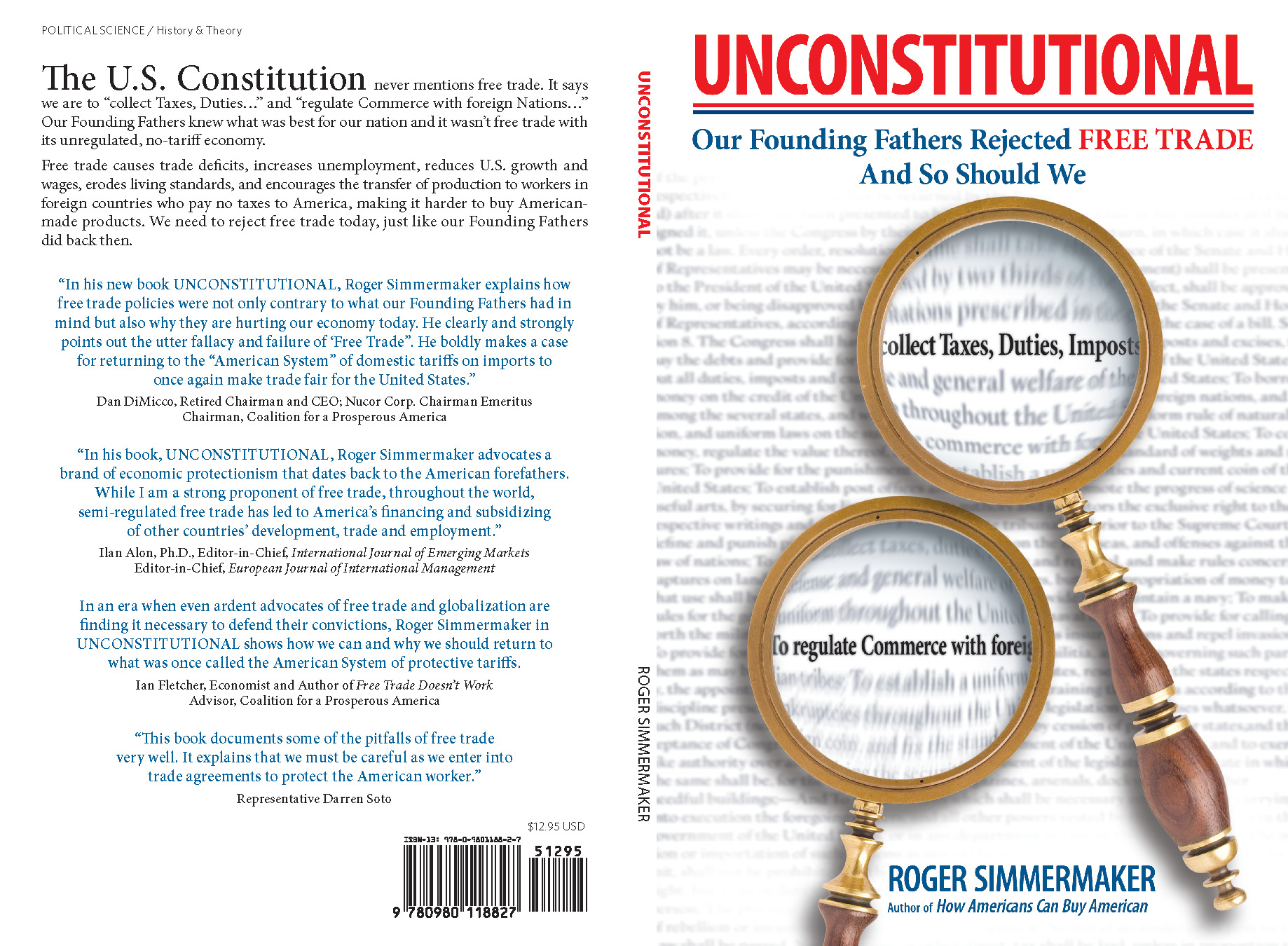
UNCONSTITUTIONAL


Our Founding Fathers Rejected
FREE TRADE And So Should We


Chapter Samples Buy the Book

Lighthizer’s terrible new book

Another free trader who think the views of Adam Smith should direct trade policy for the U.S. He refuses to acknowledge that when George Washington signed the Tariff Act of 1789, it imposed a tariff of 5 percent on the majority of dutiable imports for “the encouragement and protection of manufacturing in America.” Read the … Read More

Adam Smith’s Presumption for Unilateral Free Trade

The article states “the burden of proof is on protectionists to justify government-erected obstacles and not on free traders to justify keeping commerce free.” This is not true. The U.S. Constitution says we are To regulate commerce with foreign Nations and that Duties, Imposts and Excises shall be uniform throughout the United States. The term “free … Read More

Trump’s Trade Policies Were Poor, Sadly, Biden’s Are Much Worse

Apparently, this writer thinks President Biden’s trade stance is even more protectionist than former President Trump’s. If free traders think our trade policies are increasingly more protectionist, we should be encouraged as even more national economic prosperity is around the corner. Read the article.

CPA Statement On House Passage Of The FY 2024 NDAA

The House FY 2024 NDAA contains A provision prohibiting American taxpayer funds to be used for research in or in connection with China, but failed to include an amendment that prohibits the retirement savings of all federal employees, including Members of the Armed Forces, from being invested in China. Read the article.

China criticizes German call for reducing dependency on Chinese products as ‘protectionism’

“Anyone who listens to China knows with what self-confidence it will decisively influence the development of our world — more repressive at home and more offensive abroad,” Baerbock said. “China has changed and so our China policy must change too.” It noted that “whereas China’s dependencies on Europe are constantly declining, Germany’s dependencies on China … Read More

How Bidenomics has busted the free trade rule book

Familiar articles of economic faith like globalisation, free trade, free markets, deregulation and minimal government direction and market intervention have ceded policy ground and political support. Now the economic mantra is about national resilience and self-sufficiency entwined with national security and enforced through mechanisms like domestic protectionism and state industrial policies and spending. Read the … Read More

What the World Doesn’t Understand About China’s Ambitions

How naive that the London School of Economics professor and author of the new book “The New China Playbook,” Keyu Jin, actually believes “that one of the biggest misconceptions is that China is trying to displace the US.” In October 2022, Chinese President Xi said his goal was to ensure that China “leads the world … Read More

America is Rediscovering its Recipe for Economic Success

The “American System” devised by Henry Clay in 1812 followed Alexander Hamilton’s 1791 economic plan. Both favored tariffs, subsidies, and infrastructure development. Beijing has used the American System over the past 30 years to generate prosperity — particularly through a much larger version of subsidies, infrastructure building and industrial policy. Read the article.

GOP shift from free trade is irreversible, Trump Trade Representative Lighthizer says

“We changed the objective of trade policy away from price optimization and corporate profits and more towards jobs and workers and families,” he said. Lighthizer said that while there are “a few holdouts,” most of the brand of trade policy he and Trump championed, including prioritizing families and workers, combating China, and trying to draw … Read More

Pro-Growth Tariffs: Modified Economic Model Shows Domestic Growth

Economic models used to forecast the impact of international trade agreements have an in-built bias to favor free trade. This has led these models to underestimate repeatedly the damage done to U.S. manufacturing industry by trade agreements, dating back to NAFTA. Read the article.